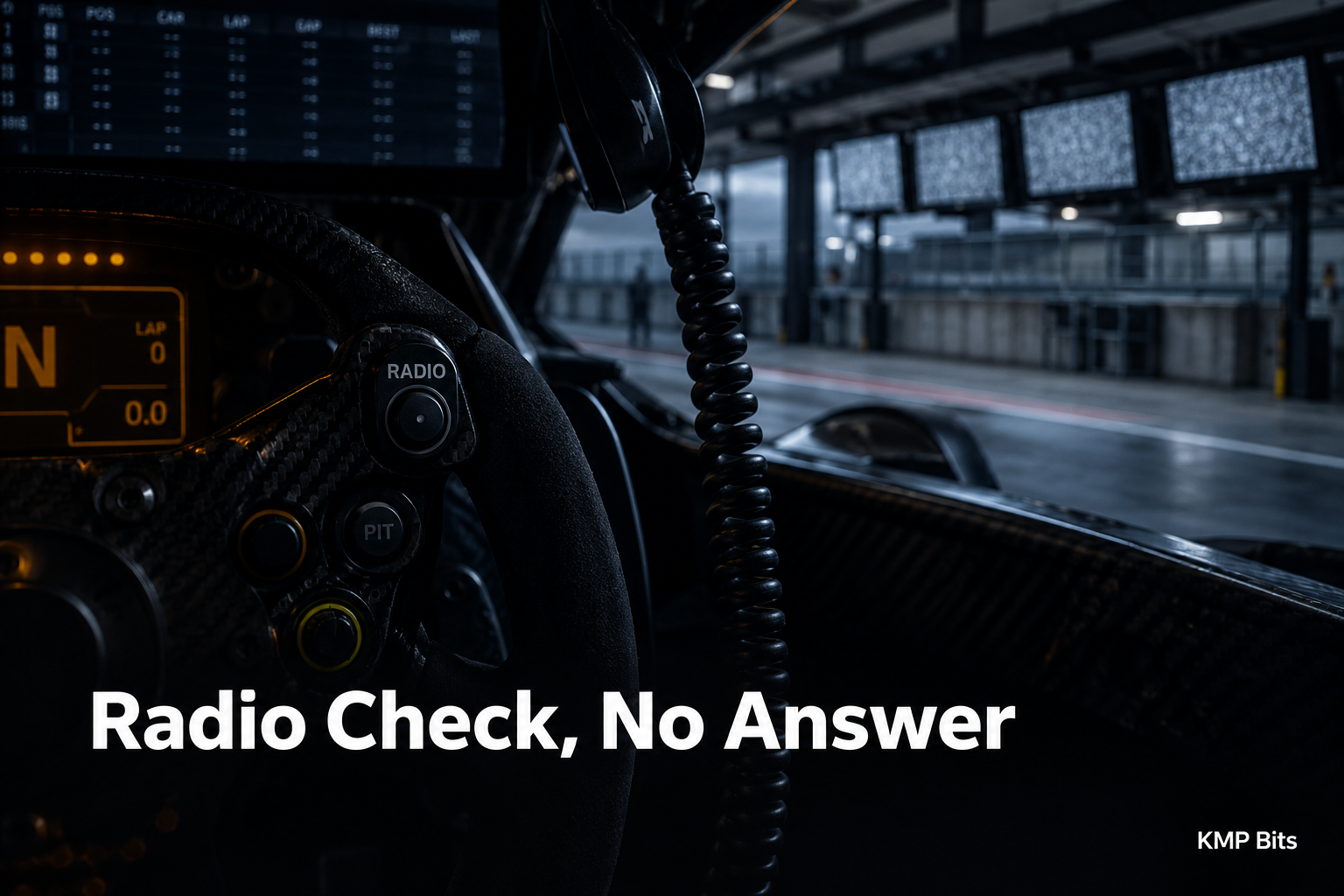
Lap 31. The rear tyres are going off and the driver feels it before the data shows it. He presses the radio button and asks the question every driver asks a hundred times a season: box this lap? Nothing comes back. He tries again on the straight. Static, then silence. Somewhere behind the pit wall a cable or a transmitter has given up, and for the rest of the race he’s on his own.
Some drivers barely notice. They read the pit board, watch the gaps on the big screens around the circuit, feel the car stepping out and make the call themselves. Others have spent so many races being told when to push, when to save fuel and when to come in that the quiet paralyses them. They stay out three laps too long and the race is gone.
The radio is a fantastic tool. It was never meant to be the only thing on the team that knows how to drive the car. A lot of companies are now building their teams as if it were.
My own radio went dead on a Friday morning in November. The email client stopped loading. The team chat wouldn’t connect. The AI assistant I had open in another tab answered with an error instead of code. Different tools, different jobs, all down within the same stretch of time.
My first reaction was mild annoyance. The second one was less comfortable. I started counting how much of what I’d planned for the day assumed at least one of those was working.
I could still write code. I’ve been doing this for over nine years, long before anything suggested a line for me. But I kept catching the reflex, the moment where I’d normally paste a stack trace into a chat box and wait.
The pit wall got smaller
Over the last couple of years I’ve watched the pit wall get smaller. Fewer reviewers, because the assistant flags the obvious issues. Less documentation, because you can just ask. Support teams cut down to a handful of people supervising an automated agent.
Then the assistant stops answering. The support queue fills up and nobody works it, because the few people left only ever supervised the agent. Pull requests pile up unreviewed, because the review was automatic and the reviewers are gone. The work stops. It’s the driver staying out three laps too long, waiting for a call that never arrives.
There’s also a slower version of the same problem. An assistant can do most of what a junior developer does, partly because a junior is still learning and most of what they produce is code. But every engineer on a pit wall today came up through the junior categories. A company that replaces its juniors with AI is also replacing the seniors they would have become. And if nobody gets the chance to be a junior today, who becomes the senior tomorrow?
Listen to the team radio during almost any race and you’ll hear some version of the same exchange. The driver says he can’t get the car to turn in at a certain corner. A lap later the engineer comes back with something like “try diff mode three”. The car turns, the lap times come down and nobody would call the radio useless. But the good drivers know that setting exists. The radio saved them the laps it would have taken to work it out on their own.
I’m not against AI at work. I use it every day and I’ve written here about building custom commands to get more out of it. A developer can stop writing boilerplate by hand and still understand every line of it. The risk starts when they can no longer read what the tool produced, judge whether it’s right, or fix it when it isn’t. Handing off the typing is specialisation. Handing off the understanding is dependence. The slide from one to the other is easy to miss, because it saves money right up to the hour it costs you a full day.
The whole grid loses the radio
This kind of downtime has a property that makes it worse than an ordinary failure. When someone on your team gets sick, the others cover. When a laptop dies, you borrow one. Most failures are local, and local failures come with local workarounds.
AI tools and the servers behind them break differently. A large part of the industry runs on a small number of providers, so when one of them has a bad hour, thousands of companies have that same bad hour together. You can’t ask the team next door for help. They’re looking at the same error. It isn’t one car with a broken radio. It’s twenty cars driving in silence, and nobody on any pit wall can tell them anything.
That’s why over-dependence is a business risk. You aren’t only betting that the tool is good. You’re betting it will be available every single hour your company needs it, and no service has ever had a perfect record.
Driving with the radio off
The teams that kept going that morning didn’t have a secret backup system. They could still read the pit board, thanks to a few habits that look boring on a normal day.
Someone still knows the code without the assistant. A person on the team can open the project, read a stack trace and fix it with the IDE and the docs, the way a good driver feels the tyres going without anyone telling him.
The reasons behind decisions live in the repo. If the only record of why the cache works the way it does is a conversation with an assistant, that record vanishes whenever the service does. Write it next to the code, like the setup sheet that stays in the garage whatever happens to the radio. It doesn’t need to be elaborate:
<!-- docs/decisions/0007-offline-feed-cache.md -->
# 0007: Cache feed responses locally

Status: accepted
Date: 2026-10-02

## Context
The feed endpoint is slow on cold start and fails often on mobile networks.

## Decision
Store the last successful response locally and show it first.
Refresh in the background.

## Consequences
Users may see data up to 24h old. The UI shows a "last updated" label.
Twenty lines that any developer can read, and any assistant too, on a good day. On a bad day they’re still there.
There’s a list of work for red-flag days. Every backlog has tasks that need a clear head more than a code generator: reviewing an old pull request properly, cleaning up flaky tests, reading the module nobody understands, updating that architecture doc. Keep a short list. When the session is stopped, the team picks from it instead of sitting in the car refreshing a status page.
No step in the pipeline depends on an AI service answering. An automated review that comments on pull requests is great. One that blocks every merge when it times out is a red flag waiting to happen. A car that can’t leave the garage without radio contact isn’t a race car. If the tool is down, the process should get slower, never stuck.
The line I hold
AI is a brilliant race engineer, and I won’t pretend otherwise. A company that lets go of the people who understand its systems, because a service understands them for now, has handed its ability to work to a server it doesn’t own. That holds up beautifully until the morning it doesn’t.
The radio should make you a faster driver, not a driver who can’t race without it. 🏁
The KMP Bits app is available on App Store and Google Play — built entirely with KMP.
Comments
Loading comments...